Ozora Festival 2026

A review set within the magical pentagon formed by psytrance, art, immersive scenographies, respectful mindsets, and a CRM system for artists/everyone
The Ozora Festival 2026 is far more than just an event on the international festival calendar. It is a temporary living space, a gigantic open-air studio, and a resonating space for people, music, and art. After four previous visits, the Ozora Festival 2026 marked my fifth journey into this special world. Once again, I experienced how traditional art, modern art, digital art, and the performing arts intertwine. Once again, the festival became a celebration for all the senses.
Outside the Ozora Stage, the encounters weren't planned on purpose; we just went with the flow.

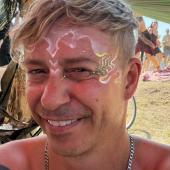
Art, Sound, and Shared Experience
What an incredible ride. What a breadth of art. What depth of perception.
The official dates for the 2026 Ozora Festival are July 24 through August 4, 2026; the venue is Dádpuszta, Hungary. My account does not follow a complete chronology of the program. It focuses on the encounters, sounds, and images I experienced firsthand that have left a lasting impression on me: the trip from Cologne, our extraordinary campsite, the energy on the dance floor, the conversations about art, humanity, and technology, and the people who turned those few days into an intense shared experience.
The Journey: Four People, One Destination
On Saturday, July 25, we set off from Cologne and picked up my brother Tommek and a friend at the train station in Nuremberg. The four of us continued our drive to Hungary. The route wasn’t the shortest, but it was part of the experience from the very beginning. In the car, we took turns discussing organizational matters, expectations, memories, and our first ideas for the festival.
Anyone heading to the Ozora Festival 2026 isn’t just arriving at a destination. Kilometer by kilometer, you break free from everyday life; you get swept up in the moment. Conversations become more open, time loses its usual rhythm, and fellow passengers become a small traveling community. For me, the Ozora Festival 2026 didn’t begin at the entrance, but on the road: with anticipation, detours, and the feeling that something big lay ahead of us.
Our Camp: Star Tent, Mobile Kitchen, and Ice Machine
After arriving, we first set up our camp. At the center was a large star tent. Inside, we created a mobile kitchen, a lounge, and a social gathering spot. We had everything we needed for meals, shade, and breaks together. We even brought an ice machine with us. With temperatures around 38 degrees, it was a quirky little extra.
Camping at the Ozora Festival 2026 became an art form in its own right for us. It wasn’t just about creating places to sleep. We built a temporary living space that combined shelter, sustenance, social interaction, and improvisation. A good camp is a stage, a living room, a workshop, and a retreat all at once. It changes with every person who cooks, discusses, sleeps, laughs, or returns from a long set.
Ice Cream as a Social Gesture
After making our first batch of ice cream, I wanted to give some of our homemade ice cream to the neighbors as a welcome gift. Since we could barely see into the RV area next door, I walked around the corner with the ice cream – and suddenly found myself standing in front of a machine that was about five times bigger than ours. Anton, a culinary artist from Nice, gave me a cheeky grin and, in a way, offered me an “all-you-can-eat” ice cream deal. What started as a friendly surprise turned into a shared joke. During the festival, Anton must have come dashing around the corner with a full ice cream sundae at least a dozen times – a treat every single time. One to zero for France.
Anton told me about his own boulangerie, Le Passage, in Nice, which he runs together with his girlfriend – who was also at Ozora. The approach described on their website matches the impression I got of the two Frenchmen from Nice: artisanal precision, bread baked on-site, butter-based pastries, fine patisserie, and a careful selection of high-quality ingredients. At our camp, that same attitude came through as spontaneous hospitality. By the way, I still have the joker, dear Anton. 😉 One to one.
Later, we lent our smaller ice machine to our neighbors from the Czech Republic and Slovakia, who had brought a large generator with them. That way, not only were we supplied with ice, but so were people all around the campground. The 2026 Ozora Festival was made up of moments like these – moments of human kindness that suddenly and in the blink of an eye brought an entire neighborhood together.
An Open-Air Total Work of Art
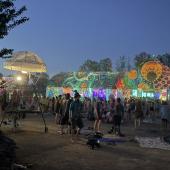
What particularly impresses me about the Ozora Festival 2026 is the simultaneity of the art forms. The visual design is not merely a decorative backdrop for the music; it is an active part of the experience. Textile structures, light, color, shadow, architecture, and movement create an immersive scenography. The dance floor becomes a walk-in installation, the body a sensor, and the crowd a constantly shifting choreographic form.
At the Ozora Festival 2026, traditional techniques meet digital aesthetics. Handcrafted-looking surfaces stand alongside electronic light art. Performing arts emerge not only in planned performances but also in the spontaneous movements of the dancers. The boundaries between artwork and audience become permeable.
This is precisely what makes “artist ritual” so significant: art is not merely viewed, but physically experienced. The Ozora Festival 2026 demonstrates how sound art, installation art, performance, digital design, and social practice can merge into a vibrant total work of art.
Ace Ventura: Energy at a Boiling Point
On the second day, Ace Ventura took the Ozora Stage at 4:00 p.m. – the first major act of our trip. Even before the set began, you could feel the crowd’s energy building to a fever pitch. Everyone wanted to dance. Everyone was waiting for the moment when the bass drum would take over the space and transform a crowd of individuals into a unified movement.
Our dance floor camp offered an extraordinary view. A hammock hung about two meters high. From there, we could look right over the crowd toward the stage. This perspective was both relaxed and intense: the movement below us, the stage in front of us, and the pressure of the sound in our bodies, transmitted through the swaying hammock.
Ace Ventura describes his musical style as a blend of hard, pumping dancefloor tracks, deeper grooves, and a psychedelic atmosphere. He views particularly long sets as narrative journeys through different realms of electronic and psychedelic music. This approach matched my impression at the Ozora Festival 2026: The set didn’t feel like a loose sequence of tracks, but rather like a dramatic arc.
The dancefloor action was nonstop yet musically nuanced. Pressure and groove, repetition and variation, anticipation and resolution were constantly in tension with one another. At that moment, the Ozora Festival 2026 made it clear why psytrance can be understood not only as a genre but as a body-based soundscape.
Music Becomes Visible: Water, Light, and Spatial Sound
I’ll never forget the magic afternoon on the third day when we headed out with our camp neighbor Arthur and his friend from Austria to see Perfect Sphere, Freedom Fighters, and Merkaba. The music was laid-back and experimental. At the same time, the dance floor was being misted with delicate water droplets. The light refracted through the droplets, creating rainbow patterns that shifted with the angle of view, movement, and rhythm. Magical. Full of variety. Much more exciting than any blockbuster on the couch at home.
It felt as though music could be seen, transformed, and restructured in three dimensions. Sound became visible. The combination of sound, water mist, light refraction, and movement created an audiovisual experience in which frequencies took on an apparent form that could be influenced by one’s own movements. The Ozora Festival 2026 exemplified how immersive art works: multiple sensory channels are linked in such a way that a new overall impression is created.
The Bassline as a Spatial Experience
You can hear a bassline. With enough sound pressure, you can even feel it. When you add light, fog, water, and the collective movement of the crowd, the bassline seems to take on a spatial quality. It gains direction, depth, and texture. At the 2026 Ozora Festival, this transformed the dance floor into an audiovisual laboratory – and dancing together with Arthur and his friend became a truly special experience.
Technical Discussions at the Camp: Development, Technology, and AI
After the first intense sets, the conversations at the camp grew more in-depth. Arthur was also there for the fifth time. This gave us a shared foundation of experience. We talked about personal development, musical evolution, music production, technology, and artificial intelligence in music.
For me, conversations like these are just as much a part of the Ozora Festival 2026 as the big sets, the painting studios, and the workshops on offer. Music is experienced on the dance floor; it is reflected upon in the camp; and perceptions are preserved in the workshops. The topics covered included production processes, new tools, aesthetic decisions, and the question of how artistic work changes when AI systems take over parts of research, organization, communication, or distribution.
AI in music production isn’t just a matter of automated or prompt-driven composition. For independent artists, metadata, artist profiles, semantic themes, search engine optimization, scheduling, communication workflows, and digital reach are also relevant. Automation can reduce repetitive work without replacing the artist’s unique style.
Dear Arthur: Thank you for the insightful discussions, for sharing our common passion, and for the time we spent together on the dance floor. For me, the Ozora Festival 2026 was also brought to life by these focused exchanges.
Altruism, Raja Ram, Lucas, and Shpongle: Magic on the Dance Floor
Another musical highlight was Altruism’s intro on Wednesday at 10:00 p.m. on the Ozora Main Stage. Even the very first moments were almost impossible to top in terms of magic. The dance floor seemed electrified: the tingling, the crackling, every pop – and even the collective breathing of the crowd – seemed to become immediately palpable. It was an incredibly magical start that didn’t just build excitement – it transported the entire space into a state of focused awareness. You dissolved, as it were, into the music and the tension, becoming one with everything. It was unbelievable – the water drop hit the spot, following the powerful bassline. Then came the collective dance ritual. Thank you, Altruism – that was phenomenal. It’s truly amazing how you conjured up this magic on the dance floor – incredible!
Altruism’s artistic profile blends harmony, versatility, and technical precision. It was precisely these qualities that could be physically experienced at the Ozora Festival 2026. The intro didn’t build through a loud effect, but through finely crafted impulses, microscopic sound events, and a dramatic structure that gradually intensified the energy on the dance floor. Individual sounds gave rise to a shared sense of anticipation; that anticipation turned into goosebumps.
Equally impressive was veteran Raja Ram. Raja Ram first performed a Shpongle set alongside Simon Posford on Friday starting at 8:30 p.m., during which Raja Ram focused on the transverse flute. In his collaboration with Simon Posford, the flute was not treated as a mere embellishment, but as a breathing, human voice within a multi-layered electronic soundscape. The melodic lines floated above the rhythmic foundation, diving into the textures and reemerging elsewhere. This blend of acoustic breath, psychedelic sound design, and live presence mesmerized the dance floor.
Raja Ram and Lucas’s joint performance on Saturday evening, starting around 8:30 p.m., also combined experience, a joy of playing, and a confident command of the dance floor. Lucas is known for a driving British psytrance sound whose roots also lie in acid house, techno, and early psychedelic club culture. Raja Ram brought that unmistakable presence with which he has been conveying psychedelic music as a vibrant, humorous, and at the same time ritualistic art form for decades. Together, they created a set that not only got people dancing but also filled the dance floor at NU after the break, transforming it into a cohesive sound body that everyone could enjoy.
Talpa: Bassline, Vibration, and Sound Massage
Another musical highlight at the 2026 Ozora Festival was Talpa on Saturday starting at 1:00 p.m. on the Ozora Main Stage. As usual, the set was incredibly bass-heavy, precise, and physically intense, yet at the same time very nuanced – and thus intriguing. In our high-hanging hammock, it wasn’t just the fabric that vibrated – it was our whole bodies. It was a sound massage in the literal sense. If you’d stood under the refreshing downpour from the fire hoses just moments before, you could let yourself dry off while vibrating up there in the hammock afterward. It’s something you have to experience – it’s hard to describe. Talpa’s bass was palpably powerful.
I also had a floor chair without legs with me – a seat with a backrest that sat directly on the ground. At first, some people looked puzzled because they didn’t understand how I could possibly stay “in the air” like that. Yeah, funny. Until they realized there actually was a support behind my back. This little scene fit right in with everyday festival life: Practical solutions sometimes look like performance art at first glance. Very often, though, this happens subconsciously, which ultimately made the humor immeasurably greater. To everyone’s amusement.
For me, Talpas Sound combined power with clear definition. The bassline didn’t stay in the background; instead, it became a central element of the composition. At the Ozora Festival 2026, this set was an example of how sound design and bodily perception work together. The music flowed through the hammock, the floor chair, my ribcage, and my spine. Sub-bass, kick drum, rhythmic modulation, and material resonance created a physical experience.
These very performances demonstrated just how differently magic can emerge on a dance floor: through the tension-filled nuance of an intro, as with Altruism; through the precise choreography of two experienced DJs; or through the breath of a flute that organically expands electronic spaces. Thank you very much for these artistic performances. I thoroughly enjoyed each of these moments.
For my personal take on the Ozora Festival 2026, Ace Ventura, Perfect Sphere, Freedom Fighters, Merkaba, Altruism, Raja Ram, Simon Posford, Lucas, Shpongle, and Talpa are therefore definitely among the musical highlights.
Jens Zygar: Gong Massage, Resonance, and Conscious Weightlessness
Another particularly profound personal experience at the Ozora Festival 2026 connected me with Jens Zygar from Hamburg. I had the opportunity to experience a gong massage with this sound artist. A space of experience opened up in which sound was focused on as a physically perceptible force at the center, rather than merely as audible music at the core of the experience.
The gong massage enveloped my body in a way that is difficult to translate into ordinary auditory terms. In my subjective perception, it felt as though the gong itself was causing even the finest traces of water in my body to vibrate. The vibrations weren’t simply present in the space around me. They seemed to pass through me, spreading out and transforming my entire body into a resonant space. At that moment, the Ozora Festival 2026 took on a whole new dimension: alongside the dance floor, the thumping bass, and the visual spectacle, I encountered a focused form of sound art that led inward.
Through the accompanying breathing techniques and phases of rapid inhalation and exhalation, I reached a consciously perceived, almost weightless state that lasted for several minutes. Time, physical boundaries, and external stimuli receded for a moment. This description reflects my personal experience; it is not a universally valid medical statement. Artistically, however, it was extraordinarily clear to me: the gong, breath, attention, and vibration merged into a single process of perception.
The official artist profile describes Jens Zygar as a musician, sound practitioner, sound researcher, sound therapist, and sound educator. According to this profile, his formative encounter with European gongs dates back to 1984. Since then, he has been exploring open sound forms, improvised compositions arising from the moment, and the question of how gong vibrations can shape perception, consciousness, and shared experience. Against this backdrop, the massage at the Ozora Festival 2026 did not feel like an isolated program item, but rather like an intense encounter with a sound practice developed over decades. His expertise was palpable.
Thank you once again for this profound experience and for the brief personal conversation afterward, dear Jens. Amid all the grand moments on stage, this encounter reminded me that intensity doesn’t always stem from volume, size, or power. Sometimes a single gong is enough when sound, breath, and attention come together at just the right moment.
Zapta by the Lake: From Stickers to Digital Visibility
One night, I was coming back from the dance floor and, as I strolled along the lake, ran into psytrance producer and resident DJ Zapta from Israel. What started as a spontaneous smoke break turned into a long conversation by the lake. Zapta told me that he travels as a psytrance producer and DJ and is looking for gig opportunities in the area. His approach so far had been very old-school: making himself visible, putting up stickers, and hoping that would lead to a connection. But how many people actually notice a sticker like that in the middle of the night? Or during the day when their minds are elsewhere? And how many of them will even remember the name “Zapta” later on?
On his official website, Zapta – formerly known as ZAPTA666 – introduces himself as an international psytrance DJ and producer from Israel. His music combines classic psytrance influences with modern production, groove-oriented melodies, vibrant energy, and cosmic atmospheres for dance floors and festival stages. This self-description aligned with the clarity with which he spoke about his artistic goals.
I explained to him that artists shouldn’t just be discoverable by their DJ names. It’s strategically more beneficial to also be visible by musical genres, roles, skills, tools, and regional or global search contexts. Whether you’re found as a psytrance producer, live act, DJ, sound designer, or performer, you expand your digital reach and increase the likelihood of receiving relevant inquiries. Zapta was extremely enthusiastic.
This requires a consistent artist profile, semantically clear texts, relevant entities, structured content, transparent areas of expertise, and automatable best-practice processes. Zapta understood the idea immediately. He didn’t want to spend nights putting up stickers in places where hardly anyone would notice them. He was looking for an automated AI agent to handle recurring tasks. It was exactly this kind of AI agent that he needed – and one that would provide lasting help not only to him but also to many of his artist friends, according to Zapta.
For me, this conversation at the Ozora Festival 2026 was a kind of epiphany – or perhaps even unintentional market research: a real need met a concrete digital concept. It was a sort of proof of concept. The next day at lunchtime, Zapta recognized me. We continued our conversation and decided to stay in touch. I hope this will develop into a long-term collaboration.
From a Sticker to a Structured Artistic Presence
A sticker attracts fleeting attention. A systematically built artist identity, on the other hand, can ensure long-term discoverability. This involves clear role definitions, consistent descriptions, semantic topic clusters, up-to-date references, and automated routines. At the Ozora Festival 2026, this abstract strategy gave rise to a personal conversation between two people by the lake.
Producers, DJs, performers, and visual artists who want to systematically develop their visibility and collaboration opportunities will find a suitable digital space on the social network ashoka ritual. You can register here: www.ashoka-ritual.com
MUMUSH: Freedom, Art, and the Courage to Let Go of Old Fears
I’d also like to highlight the conversations I had with the organizers of the MUMUSH Festival, with whom I engaged in lively discussions on the dance floor and partied hard. This encounter took on even greater depth in retrospect when I carefully read the MUMUSH Manifesto. For this, I’d like to express my utmost respect. BTW, here you find ours.
The manifesto uses the figure of “Mumus” – the eerie bogeyman whose form looks different in every imagination – as a metaphor for ancient fears. Its central idea can be understood this way: Fear is not just something that comes from the outside; it takes on a face through what we accept, project, and hold onto. Art, by contrast, is conceived as a force of freedom. Creativity, conversation, music, and self-expression create spaces in which people can recognize their inner fears, reimagine them, and ultimately let them go.
The connection between personal freedom and ecological responsibility is particularly strong. The MUMUSH Manifesto does not call for conquering nature, but rather for connecting with it. Community is described as a growing process that brings together awareness, acceptance, sustainability, and creative change. Good music, workshops, jams, dialogue, and relaxed time spent together are not just random program items, but an expression of an attitude.
These ideas aligned remarkably well with my experience at the Ozora Festival 2026. There, too, freedom arose not through separation but through connection: with other people, with one’s own body, with sound, water, heat, and the landscape. The dance floor became a place where one could be oneself without having to fully explain oneself.
Unfortunately, I’ve forgotten the name of the tall man with the distinctive goatee, whom I perceived as a central figure in the Romanian crew. Nevertheless, I’d like to express my deepest gratitude and utmost respect to him here. Perhaps these words will reach him. I’ll always remember our conversations at the Ozora Festival 2026.
Realization of Origin: Relationships, Patterns, and Sustainable Living
Many thanks also to Mona, with whom I had the pleasure of engaging in fascinating conversations at our camp. We spoke about understanding human nature, personal development, empathy, patterns, communication, and sustainable living. Topics like these can easily become abstract concepts. In our personal exchanges, however, they took on concrete form: How do we recognize recurring dynamics? How do sustainable relationships develop? How can communication provide guidance rather than creating new misunderstandings?
Mona Gergeleit’s work with Realization of Origin offers a well-founded framework for these questions. Her approach is based on the premise that the challenges of our time cannot be viewed in isolation, because people, nature, culture, and society are interconnected. Psychology, philosophy, anthropology, ecology, systems thinking, cultural studies, spirituality, sustainability, and lived experience are not treated as separate islands of knowledge, but are interconnected.
Particularly relevant to our discussions at the Ozora Festival 2026 was the focus on patterns and connections. If one looks only at individual conflicts, symptoms, or behaviors, it’s easy to overlook the relationships in which they arise. Systemic thinking, therefore, doesn’t ask only, “What happened?” It also asks, “What interactions, stories, needs, and cultural influences are at play here?”
Mona also shared insights into her teachings and expertise in the field of the healing arts, as well as her experiences in South America. Her website describes long journeys, encounters with indigenous communities, intense experiences of nature, and several years spent primarily in South America; today she lives and works mainly in Peru. In her work, these biographical experiences come together with the goal of making knowledge applicable to everyday life and providing guidance in a complex world.
Thank you very much, Mona, for the open conversations and the insights into your perspectives. I hope we’ll see each other again someday. I also hope that you and everyone else made it home safely. The 2026 Ozora Festival showed me once again how much an attentive conversation can achieve when people are willing to share experiences with one another without jumping to conclusions.
Art is created between people
Not all art at the Ozora Festival 2026 hangs on a wall or plays through a sound system. Much of it emerges from relationships: while cooking together, sharing ice cream, setting up a shade canopy, during a late-night conversation, or in an analytical discussion about music technology, fears, development, and sustainable living.
That’s exactly how our camp worked. The mobile kitchen wasn’t just technology. The ice cream maker wasn’t just a supply. The hammock wasn’t just a piece of furniture. Through use, conversation, and shared experiences, every object became part of a social system. For me, the Ozora Festival 2026 was therefore also a school of systems thinking in everyday life. People, infrastructure, environmental conditions, art, and technology weren’t separate spheres. They constantly influenced one another.
Neighborhood as a Collective Endeavor
David from Hamburg joined us at our Dancefloor Camp and proved to be a true expert when it comes to the art of partying. We had an amazing time. Then there were our wonderfully crazy neighbors from the Netherlands, who used their technical expertise to expand our canopies. What was initially intended as simple shelter was collectively improved.
This collaboration wasn’t an officially curated art project. Nevertheless, it had creative merit. People analyzed the space, the sun, the materials, and the flow of movement. They adapted the structure and created a better environment for everyone. At the 2026 Ozora Festival, design thus became a collective practice. No single designer determined the outcome. The structure evolved through observation, experience, and collaboration.
The tent community as a whole also shaped our experience there. We had long conversations, shared resources, and enjoyed music together. Anton was there with his father and his girlfriend. Thanks, Anton, also for the Joker story.
Such small mementos anchor a major event in something concrete. Later on, they may be more memorable than some spectacular light shows because they remain tied to a personal connection.
Water as a Form of Care: Respect for Daily Efforts
With the heat, water was a central theme. On five or six days, large quantities of water were used to cool the crowd. Ten or fifteen full loads in a single day, which the fire trucks poured over the crowd, were standard practice. They transformed the situation both physically and emotionally.
At the 2026 Ozora Festival, water thus became part of the festival’s dramaturgy: as protection against overheating, as a collective moment of refreshment, and as a medium for refracting light on the dance floor. I have great respect for this repeated effort. It is precisely during a heat wave that it becomes clear whether a festival space is organized merely for spectacle or with genuine care. The water activities were pure excess and release – and at the same time, a necessary form of collective care.
What Artists Can Take Away from the 2026 Ozora Festival
The Ozora Festival 2026 demonstrates that contemporary art does not have to be confined to rigid categories. Music can be architecture. Camping can be design. Cooking can be art. A conversation can become the starting point for a digital strategy. A mist of water can trigger a light installation. A hammock can become a listening room. A manifesto can retrospectively lend philosophical depth to a chance encounter.
- Think interdisciplinarily: Sound, image, space, the body, and technology can reinforce one another.
- Understand community as a medium: Networks emerge through shared experiences, trust, and reliable relationships.
- Structure visibility: Artistic quality requires understandable concepts, relevant contexts, and digital discoverability.
- Using technology in a human-centered way: AI and automation should reduce routine tasks, leaving more time for art and human connection.
- Recognizing patterns: Relationships and interactions often reveal more than isolated individual events.
- Combining freedom with responsibility: Creativity gains strength when it includes respect for people and nature.
- Allowing for improvisation: Many of the most powerful moments at the Ozora Festival 2026 were unplanned.
My conclusion: Art as a ritual and a collaborative process
For me, the 2026 Ozora Festival was a celebration of perception and a gathering place for people from various artistic disciplines. The most powerful impressions didn’t come solely from the big names. They arose from the interplay of music, visual art, water, light, heat, technology, conversation, and community.
Ace Ventura demonstrated how a DJ set can dramatically channel collective energy. Talpa transformed bass into a physical massage. Jens Zygar helped me perceive sound – through gongs, breath, and resonance – as an inward-focused space of experience. Zapta made it clear how urgently artists need contemporary avenues for digital visibility. Anton combined culinary craftsmanship with generosity. Arthur blended the festival experience with thoughtful conversations about the evolution of music and AI. The people at MUMUSH reminded me that art can create freedom in the face of fear. Mona deepened our perspective on relationships, patterns, communication, and sustainable living.
Altruism created an almost intangible buzz right from the intro; Raja Ram and Lucas combined experience with dancefloor dramaturgy; and Shpongle transformed Raja Ram’s flute playing into a hypnotic bridge between breath, live instrument, and electronic sound architecture.
At my fifth edition, it became clear to me once again: The Ozora Festival 2026 isn’t just a place to be a passive participant. You help shape it—through attentiveness, a willingness to help, creative ideas, professional exchanges, and the openness to connect with others and celebrate the Dance Trance Ritual together.
Finally, a thought for my friend Chris, who was there with his girlfriend and kids. Unfortunately, we didn’t manage to run into each other. In fact, cell service was mostly terrible. It’s curious, though, that we both apparently tore ligaments at the same time during Ozora, as our phone conversation on the way home revealed. For now, I wish us both a speedy recovery and hope to see you next year, Digga. After all, 2011 was our first Ozora Festival together.
For me, the 2026 Ozora Festival remains a particularly powerful example of art as ritual: not as a finished production, but as a shared process. Many thanks to everyone mentioned—and those not mentioned—for the time we spent together. I hope you all made it home safely.
Anyone who, after the 2026 Ozora Festival, would like to deepen new artistic connections, raise the profile of projects, and collaborate across disciplines... ashoka-ritual.com
Editorial Sources
- O.Z.O.R.A. Festival 2026 – official festival dates: https://2026.ozorafestival.eu/
- Ace Ventura – official website and artist biography: https://www.aceventuramusic.com/
- Zapta – official artist website: https://zapta-music.com/
- Le Passage, Nice – artistic profile: https://www.lepassagenice.com/
- Realization of Origin – About Mona Gergeleit and her research approach: https://realizationoforigin.org/ueber/
- MUMUSH – Manifesto: https://mumush.world/manifesto
- Altruism – official artist page: https://www.nanomusic.net/artist/altruism/
- Raja Ram – official artist profile: https://www.tiprecords.com/artists/raja-ram/
- Lucas O’Brien – official artist website: https://www.djlucasobrien.com/
- Shpongle – official project and artist website: https://www.shponglemusic.com/
- Jens Zygar – artist profile and sound work: https://klanghausmedia.de/jenszygar/